
%20(1).jpg?width=300&name=wp9131686%20(1)%20(1).jpg)


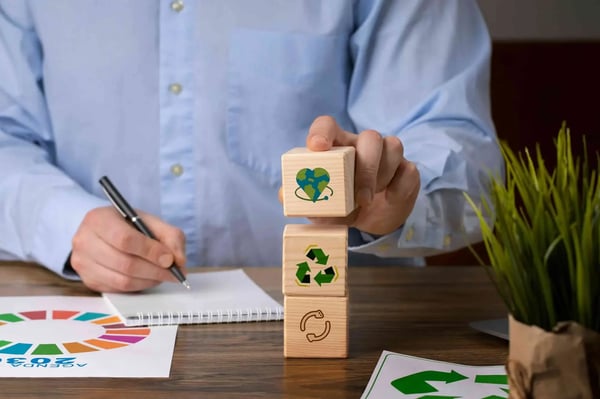
In an increasingly demanding global market, the manufacturing industry faces a dual challenge: maintaining competitiveness while responding to the growing demand for sustainability. In this context, understanding the differences between the linear model and the circular model is essential for managers seeking strategies to reduce costs, optimize processes, and minimize environmental impact.
This article analyzes both models, outlines key implementation strategies, and presents success stories that demonstrate how the circular economy in manufacturing can generate both economic and environmental benefits simultaneously.
<<<Strategic Planning: The Key to Sustainable Growth>>>
Linear vs. Circular Model: Two Opposing Visions
For decades, the global economy has relied on a linear “take, make, dispose” model. This approach has driven industrial growth, but at a high cost: depletion of natural resources, waste accumulation, and a significant environmental impact.
The circular model, by contrast, proposes a regenerative system where resources are kept in use for as long as possible. Waste is transformed into new resources, and products, components, and materials are continually reintegrated into the production cycle. This paradigm shift drastically reduces waste, lowers carbon emissions, and extends the value of resources.
<<<Circular Business Models: Transforming Waste into Resources>>>
Key Strategies for Implementing Circular Economy in Manufacturing
1. Eco-Design
Eco-design incorporates environmental criteria into all stages of the product life cycle: from material selection to usage and end-of-life disposal. The goal is to minimize negative impact and optimize efficiency. IKEA, for example, has successfully integrated eco-design into its production chain, creating more sustainable products without sacrificing functionality or profitability.
2. Industrial Recycling
Integrating efficient recycling systems within factories reduces waste and recovers valuable materials that can be reincorporated into production. Tesla, through its battery recycling program, has managed to reduce its carbon footprint and optimize costs, proving that sustainability and profitability can go hand in hand.
3. Product-as-a-Service (PaaS)
This model replaces traditional sales with a continuous service, keeping product ownership and maintenance in the hands of the manufacturer. This gives companies a direct incentive to create more durable and efficient products. Philips applies this approach with its “lighting as a service” program, optimizing resource use and ensuring responsible maintenance.
Success Stories: Measurable Results
- Interface – This carpet manufacturer has incorporated bioplastics, material recycling, and circular processes, reducing its carbon footprint by 98% since 1996.
- Unilever – By optimizing its supply chain under circular principles, it has cut costs, minimized waste, and improved efficiency across global operations.
These cases show that the shift toward a circular model is not only viable but also profitable and scalable.
Measuring to Improve: Sustainability KPIs
To evaluate the success of circular economy initiatives, it is essential to define key indicators such as:
- Reduction of CO₂ emissions.
- Decrease in waste sent to landfills.
- Increase in the use of recycled materials.
- Improvement in energy efficiency.
- Reduction in raw material consumption.
- Extension of product life cycles.
These metrics enable organizations to measure real progress and continuously adjust their strategies.
<<<How to integrate sustainability into 2025 strategic planning>>>
Conclusion: From Environmental Duty to Competitive Advantage
The transition to a circular economy is no longer optional but a strategic necessity. Adopting practices such as eco-design, recycling, and the Product-as-a-Service model not only reduces environmental impact but also drives efficiency, innovation, and competitiveness.
The future of manufacturing will depend on companies’ ability to integrate these models and measure their progress consistently. As highlighted by leading reports such as those from the Ellen MacArthur Foundation, organizations that spearhead this change will not only comply with regulatory and social demands but also position themselves as sustainability leaders in their sectors.
Circular economy in manufacturing is not a passing trend—it is the foundation of a resilient, future-ready production model.


Comentarios